
Dennis Meadows - Grow, Grow Forever?
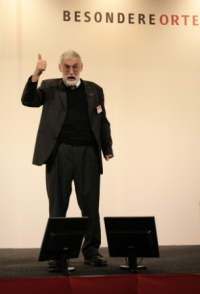
Dennis Meadows (Photo: Jan Konitzki) 
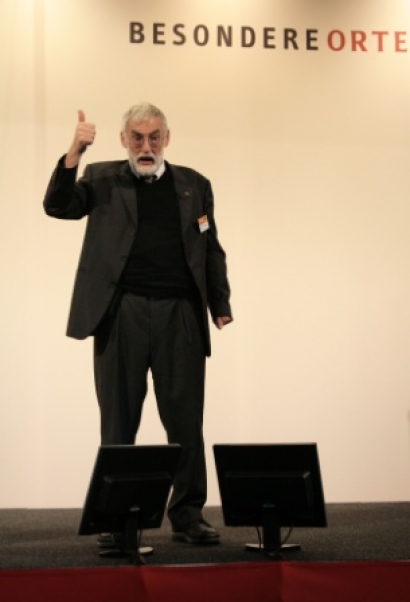

(born 1942) was Professor at the Massachusetts Institute of Technology (Cambridge University), at Dartmouth College and at the University of New Hampshire. There he was teaching engineering, management and social science. Today he is Professor Emeritus and Director of the Laboratory of Interactive Learning in New Hampshire. Meadows is the author of the report to the Club of Rome „Limits to Growth"(1972) which is one of the first books modeling the impact of population/economic growth bearing in mind finite resource supplies. Furthermore Meadows is a member of the Club of Vienna and cofounder of the Balaton Group. In 2009 he was awarded with the Japan Price.
Citation relating to the conference theme:
"We are on a treadmill that spins faster and faster but leads nowhere. In order to produce more and more physical goods, people, culture, and the environment have been degraded in ways that prevent them from offering the qualitative satisfactions they used to give."

(Photo: Jan Konitzki)

Abstract of his speech
"Most citizens in the industrialized nations have come to believe that the physical expansion of the global economy is inevitable. But when faith conflicts with reality, the latter eventually prevails. Growth will soon come to an end along one of two paths. Either humanity can turn to the pursuit of quality rather than quantity, or problems such as climate change and oil depletion will bring on stagnation and decline despite our best efforts to sustain a rising GDP. The first path gives us a chance to achieve many of humanity's basic goals. The second holds the potential for enormous strife, frustration, and dislocation.
The unfolding economic crisis that started last year will not soon disappear. It is just one example of the problems that will grow until population and material growth have been brought to an end within the capacities of the planet. There will be more changes in economy, politics, and environment over the next twenty years than we have witnessed during the past century. Countries and regions that assume they can pass through this period unscathed simply by pursuing traditional policies will suffer - massively. Degrowth is no longer a philanthropy you undertake for others; it is an essential strategy for survival.
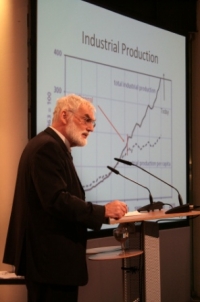
Dennis Meadows (Photo: Jan Konitzki)
There is no possibility to support 7-9 billion people on this planet at material consumption levels similar to those witnessed in the richer countries today. But starting now an ernest effort to shift from quantitative to qualitative development could permit some regions to minimize the damage to their own standards of living and environment that they will otherwise sustain as we enter the period of human history that witnesses a transition to negative growth rates.
The coming decades can be either a severe trial or they can be an opportunity for humanity to refocus on its essential goals."
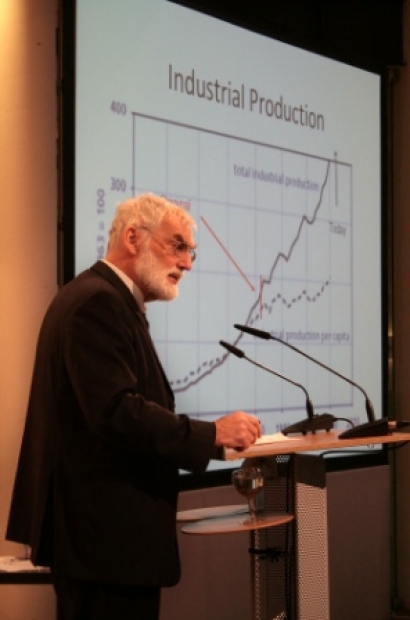
Dennis Meadows will describe the system structures that have brought exponential growth in industrial output to the richer areas of the world and explain the forces that will arise over the coming decades to stifle that growth. Using climate change as an example, he will illustrate the relation of science to politics in determining future options. He will suggest that contemporary critics of growth predicate their calls for change on a wrong assumption. "We should not question growth because we want to do something useful for others later. We urgently need to revise our policies to secure our own future welfare."
Dennis L. Meadows